from
http://luxurylivingtips.com/regent-seven-seas-cruises-orders-a-new-luxury-ship/
NEW YORK – The growth formula that luxury brands have relied on in recent years is already failing, according to an executive from Exane BNP Paribas at the FACC Luxury Symposium 2016.
Recently, the luxury sector has been reliant on growth in China and among Chinese consumers and has responded by increasing prices and opening more stores. However, a number of deflationary forces are already hampering in this route, and luxury must now find a way to generate growth.
“It’s not that the formula is not going work in the next two years,” said Luca Solca, managing director, global luxury goods at Exane BNP Paribas. “The formula we looked at hasn’t worked for the last two to three years. The change of ROIC in 2012 and 2014 is -5 percent.”
FACC Luxury Symposium was organized by French-American Chamber of Commerce.
Subhed1
Although increasing prices has long been a strategy for increasing revenue, as a large percentage of valuable clients have both the loyalty and means to ignore incremental price increases, the strategy is no longer working. Mr. Solca showed that a large sampling of brands has expanded the gross margin by five percentage points over the past five years.
Hugo Boss New York Fifth Ave store
A number of significant opposing forces, however, set this strategy up for failure. The growth luxury relies on is from China’s middle, not upper class. These consumers have shallower pockets and are far more concerned about prices than the richer, early adopters.
The Internet also allows these consumers to have more access to pricing information than in the past. This information has led many to plan trips outside the mainland around the prices of luxury goods.
Meanwhile, authorities are attempting to reduce the amount of money being spent in other countries and increase tax revenue. This pressures luxury brands to reduce prices in China, but this will consequently reduce the consumer class’ spending abroad.
Chinese tourists outside a Louis Vuitton boutique
Lastly, many accessible luxury brands are building inroads with the Chinese consumer by offering products at entry-level price points. As a result, other brands do not have the option of reducing the price gap with China by increasing prices in core markets.
On the retail side, growth initially looks deceptive. Between 2013 and 2015, the number of retail stores by the brands Mr. Solca examines grew 4 percent. However, Tory Burch and Michael Kors alone are responsible for three-quarters of that growth.
From 2012 to 2014, there has been a drop in ROIC, a metric that is very highly correlated with the price of shares.
Over its history, luxury has grown in waves, with the most recent wave being the influx of Chinese consumers. From 2005 to 2015, the luxury market grew by 6 percent, with Chinese consumers accounting for two-thirds of the growth. With China slowing, brands must find new ways to grow.
Among the ways in which brands can do this, it begins with the basics. Brands must boost their desirability. Without a major growth driver, doing better than competitors is very important as brands fight for smaller margins with lower-spending consumers.
Closely related, tighter capital allocation and cost efficiency will aid growth. With revenue sources drying off, cutting costs offers another place to increase revenue. Brands must also prioritize digital channels and travel retail, as people on the move buy at least half of luxury goods.
In the digital retail space, Exane BNP Paribas found that in 2013 the average cross-channel consumer spent 40 percent more than the in-store-only consumer and that in 2014 the number increased to 60 percent. These figures show that consumers are not merely translating their purchases from in-store to online; instead, consumers comfortable in both spaces are buying more than they would otherwise.
Executives remain optimistic despite the current pause. Around half of those in the room expect their brand to grow by a modest 3-5 percent in 2016 and 2017, but an additional 20 percent forecast growth of 6-10 percent and a small portion expect even more.
The optimism suggests that brands are already tapping into potential omnichannel growth. However, Exane found that performance in omnichannel servicing is generally lacking.
While the majority of executives in the room said that being able to return or pick-up an online purchase in-store is important, Exane found that many brands do not offer that option.
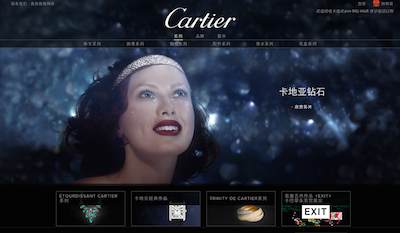
Cartier Chinese ecommerce site
“The Holy Grail for luxury brands is to integrate physical and digital operations,” Mr. Solca said. “That’s where the value will come from.”
With integrated operations, digital can serve as a traffic feeder to store and increase traffic conversion, as those coming for in-store pickup are upsold by an effective sales staff. Stores will also be able to leverage cross-selling opportunities and increase the convenience of online purchases.
Subhed2
While 85 percent of retailers consider unified commerce a top priority, most are not making enough of an effort in upgrading their infrastructure to achieve a fully seamless shopping experience.
According to a recent report from Boston Retail Partners, retailers have attempted to reformat their outdated systems to accommodate cross-channel capabilities, leaving many with “faux omnichannel.” As the consumer comes to expect a uniform service across channels, retailers are at risk of losing clientele if they do not implement a more holistic system (see story).
Brands must also ensure they pay close attention to consumer confidence patterns and the economic developments of Asia as a whole and China in particular. Even if China will not be the primary driver of growth to the same extent they have in the past 10 years, the market is still large and growing.
Consumer confidence in Mainland China is showing signs of growth, while Hong Kong consumers are expected to be more conservative in their luxury spending, according to a new report by Ruder Finn and the Consumer Search Group.
Forty-two percent of Mainland consumers expect to raise their luxury spending in 2016, but just 25 percent of Hong Kong residents say the same, whereas 30 percent said they would be spending more in 2015. However, while Hong Kong consumers may be curbing their spending, they are still interested in exploring new luxury brands and services, and the luxury industry should not discount the city (see story).
“I think the Chinese, at the end of the day, if all goes by plan, will be about average,” Mr. Solca said. “I expect the Europeans to continue to lag and Americans to be broadly along the average.”
China’s Alibaba and luxury ecommerce platform Mei.com are joining forces to launch a luxury flash-sale channel, giving consumers access to authentic, discounted fashion items.
The new Tmall Luxury Flash-Sale Channel made its official debut with a star-studded runway show on March 30, during which millions of consumers tuned in to watch and purchase the 42 looks immediately available on Tmall’s mobile phone application. Selling pieces from more than 300 labels including Armani, Ermenegildo Zegna and Stuart Weitzman, the new shopping platform creates a place for Chinese consumers to purchase international luxury brands with confidence.
Making an entrance
The Tmall Luxury Flash-Sale Channel event was live-streamed on Tmall’s app, allowing consumers to join in the festivities no matter where they were. Once they had entered the scan and buy fashion show, consumers could shop the looks as they came down the runway.
Throughout the show, 30 women’s wear, 10 menswear and two children’s wear looks were featured. Models were styled in a variety of labels, from Proenza Schouler and Sergio Rossi to Galeries Lafayette and Longchamp.
Mei.com is the authorized retailer for 3,000 brands in China, and the international retailer brings a relationship with luxury brands to this partnership.
Style icon Olivia Palermo put together one of the looks seen on the runway. She then sat front row during the show in the same ensemble.
Chinese actor Peter Sheng, most well known for his Web series “Go Princess Go,” walked during the show in a Carven suit, making his runway modeling debut.
A number of luxury brands have launched ecommerce sites in China within the past year, but online shopping still feels like risky business to many of the country’s consumers, according to a new report by FDKG.
FDKG’s “Luxury Insights China 4th Quarter” report explains that with less regulation of online sales in China, consumers may have to endure a drawn out dispute if items are not delivered as promised, making each purchase a consideration of not only spending budget, but a weighing of how much can comfortably be lost. While some may still opt for an in-store purchase, a growing interest in online shopping within China is evident in the $14 billion in transactions during Single’s Day Nov. 11 (see story).
Baghera/Wines held its first Wine O’clock sale on March 29, selling all 43 lots using an online reverse auction strategy, showing that oenophiles’ purchasing habits have evolved.
Wine O’clock was a 100 percent online auction that priced lots from high to low on a dedicated hub housed on Baghera/Wines’ Web site. The auction house industry has been rejuvenated by integrating digital bidding blocks that allow for a global audience to interact and purchase high-end goods no matter their location.
“The backbone idea of our Wine O’clock sale concept is the very limited time-availability of the wines offered online,” said Michael Ganne, executive director at Baghera/Wines, Geneva. “The bidders only have a couple of hours, or even less, to purchase high-end wines at the best price. The first online user to click on the desired lot wins.”
Always time for wine
Baghera/Wines’ Wine O’clock auctions are one-off and are theme-based, providing niche segments of wine connoisseurs the chance to interact with lots they are interested in.
Unlike a traditional auction, Wine O’Clock lots are priced high to low, with the price of items decreasing over a period of time. Competition among bidders during a reverse auction is also higher than regular sales, as the first user to click wins the lot.
Due to the speed and high to low pricing strategy, sales of each lot typically last less than three minutes. Bidders are also able to buy high-end wines for a fair price with a single click.
“With our Wine O’Clock concept, we want to break all previous codes of how things are done, and inject a new dimension into the world of exceptional wine auction sales,” Mr. Ganne said in a statement. “Our desire is to continue offering rare and prestigious high-end wines, but in a more modern, accessible and in particular, a more fun way.”
For the inaugural Wine O’clock auction the theme emphasized the Château Lafite Rothschild and Carruades de Lafite, winegrowers from the Bordeaux region of France.
The auction featured 43 lots of magnum, vintage bottles of Château Lafite Rothschild wines, dating between 1966 and 2010. A number of the lots were offered in wooden boxes, upping the value of the wines.
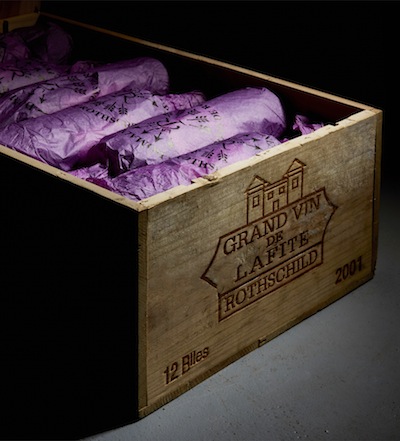
Wine O’clock lot housed in its branded wooden crate
During the online auction Baghera/Wines noted that most participants were wine connoisseurs based in either Europe or Asia. Recently, the Asian market has seen a surge of interest in fine wines, resulting in high demand from consumers and providing opportunities for publishers to feed this growing enthusiasm for oenology.
For instance, Le Pan, an international magazine and Web site, is aiming to redefine coverage of the fine wine industry with an emphasis on modern-day fine living was launched in March 2015.
Published by Hong Kong-based publisher LPM Communications Limited, the imprint, lead by publisher and CEO Jeannie Cho Lee, the first Asian Master of Wine, has a wine to lifestyle ratio of 80:20. Its origin and connection to the Asian market is a reflection of the region’s growing interest in fine wine and luxury goods (see story).
One such buyer from Hong Kong told Baghera/Wines, “I am delighted with my experience of joining the inaugural Wine O’Clock, and so completing my personal ensemble of great Clarets. The Web site is an easy and instinctive tool.
“Reverse bidding brings a real hint of fun, excitement and suspense that can sometimes be lacking in more traditional auctions.”
The first Wine O’clock auction hosted by Baghera/Wines found that of the 43 lots of Lafite Rothschild on auction, numbers 2, 3 and 35 were the most sought after among participants. These three lots sold for $9,880 for 6 magnum 1986 bottles, $9,511 for 12 1986 vintage bottles and $8,509 for 12 bottles of a 2003 vintage, respectively.
Wines of Lot 2, sold during the Wine O’clock auction
Baghera/Wines plans to follow up the March 29 Wine O’clock auction with a sale on April 19. This auction will be dedicated to Sassicaia wines from Italy.
Not your old time auction
One such auction house that is looking to revamp the current structure of its industry is Sotheby’s.
For instance, Sotheby’s is writing its next chapter with the launch of a mobile application for iPhone and iPad.
The multinational corporation was established more than 270 years ago and continues to thrive, indicating a willingness to adapt to changes technological and otherwise, with the app being merely the latest step. An increased mobile presence is a necessary step in connecting with an increasingly mobile audience (see story).
Also, Sotheby’s looked to disrupt the auction industry by turning to a new channel.
On Dec. 10, the Sotheby’s Apple TV app was launched with the “Driven by Disruption: New York City” automotive sale. Sotheby’s year has been defined in part by initiatives that give it a larger online presence (see story).
World Travel Library posted a photo: